The Next 250 Years


My dad is a coin collector. The coins he was least interested in were always the ones that most captured my attention as a child. The '76 Bicentennial Quarter was my favorite.
Unlike today where the reverse of a quarter might be stamped with one of the 50 states or a notable American woman, the quarters of my youth were all pressed with the same backing, an eagle. To flip over a quarter and see the patriot drummer of the Bicentennial was a novelty. My dad had saved rolls of quarters from 1976 predicting that they would increase in value during his lifetime.
But alas, they are still worth 25 cents. Even on the eve of the sesquicentennial, there is still nothing truly rare or valuable about them.
Yet.
As we look ahead to America's next 250 years, will our fears and predictions about the role AI will play in our lives also be overblown?
Of course it's too early to tell, but this summer I have been focusing on the ways that language shapes how we think about AI and how we design the future we want to live in. The heaviness of middle age and beyond is knowing that the work you do now is not necessarily for you. You might not live to see the changes you set in motion (your kids might not either). But that doesn't mean you stop. Where prediction markets are all the rage right now (and a possible way to make a quick buck), I'm betting on the long game.
Here's some of what I have been up to:
In May, my colleague, philosopher Dan Fernandez, PhD and I led a facilitated dialogue at Stony Brook University during the SUNY Conference on Instructional Technology around the question: How can we build an AI literate and human-centered classroom community in all teaching modalities? We're co-authoring a paper on this topic that we hope to make available this fall (link to follow).
I met so many inspiring people doing great work in the field of public information technology at the NYU AI Summit sponsored by the Faculty Resource Network. Over three days we heard from a dynamic lineup of speakers from BlackTechFutures and Google. Some of the highlights included, LatimerAI, a culturally fluent alternative to GPT that aims to reduce output bias, Wilson and Northington's work on the impact of Data Centers on HBCUs, and Styles' research on the problems of "the human in the loop" approach to AI implementation. Styles' team put together this primer on the Theory of Interrogative Reasoning, a community-centered framework that reconceptualizes ethical AI as a function of power, belief, and timing rather than solely technical design. I also had the opportunity to give a brief lightning talk on resisting anthropomorphism in AI (Possibly a Video to Follow).
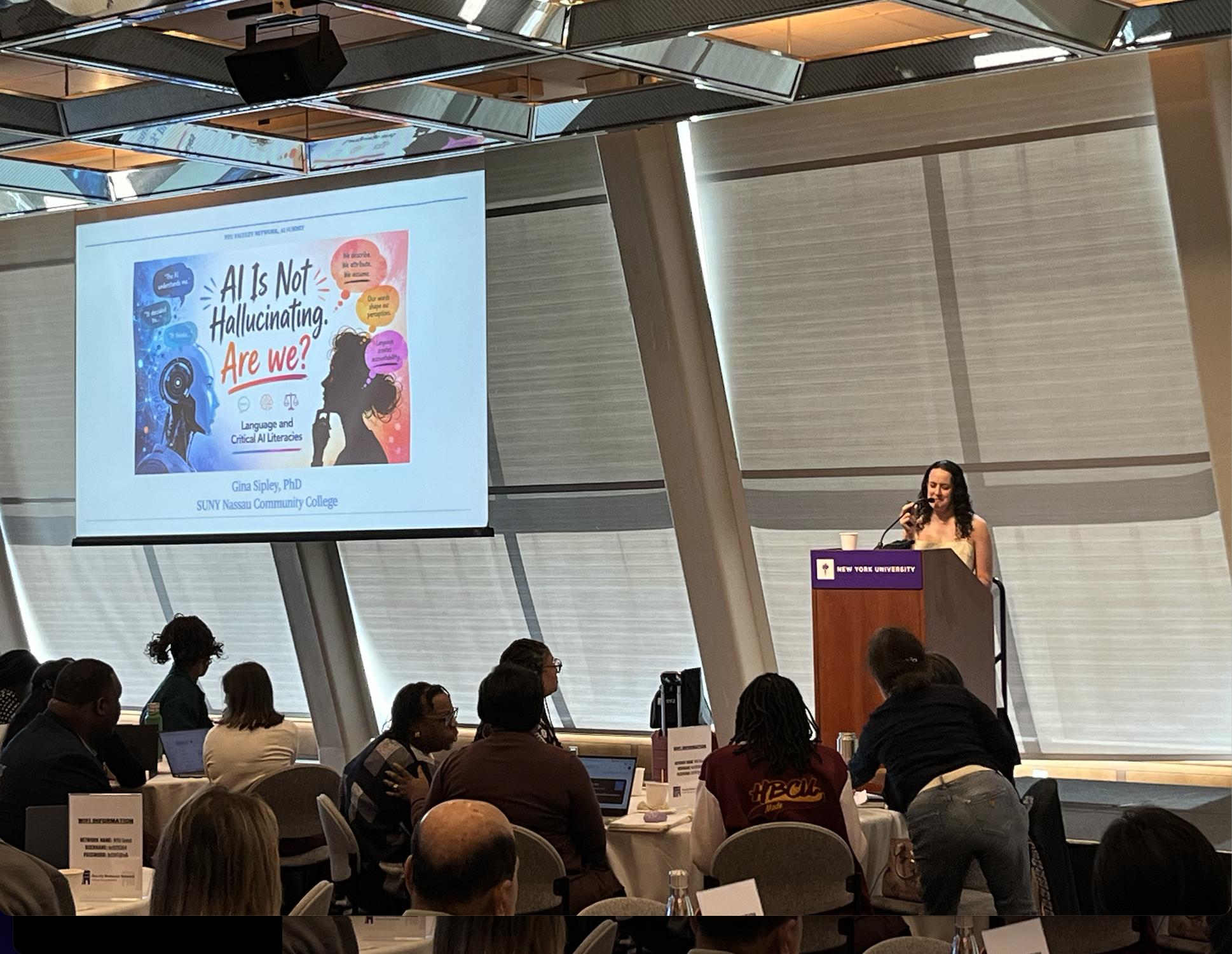
Over the summer I'm working with a brilliant research team, led by colleagues at Stony Brook University, University of Albany, Farmingdale State College, and my home campus of NCC, that was awarded a 56K IITG grant to design trainings to preserve writing as a vehicle for learning in the age of AI.
If you're interested in reading more about AI in context, the problems and possibilities, and how you can shape the future, I've got a shelf on Aurora Bookshop with some recommended reads.
Thanks for walking beside me,

If you know someone who might be interested in receiving this newsletter, please forward and encourage them to subscribe.