Lurkers in the Parasocial Age


Through a combination of surveillance, fears, and fatigue we are scrolling more and posting less.
As dana boyd (2026) explains that for these reasons we are living in a time of parasocial media.
"One of the striking characteristics of the new mass media [...] is they give the illusion of face-to-face relationship with the performer"
This is a quote not from boyd, but from Mass Communication and Parasocial Interaction: Observations on Intimacy at a Distance by Donald Horton and R. Richard Wohl.
It was written in 1956.
The ellipses conceal that they were discussing the new mass media of radio, television, and the movies.
This conversation isn't new; it's heightened.
But way back in 2015, dana boyd, in conversation with Henry Jenkins, and Mizuko Ito, was already posing the question, "can someone be a valuable and participatory lurker?"
This is the question I set out to explore in my book, Just Here For The Comments, about the literacy practices of lurkers.
Lurking has always been a valuable and participatory act, but in the age of parasocial media, its importance is central because it seeks to illuminate how we react beyond the visible trace of public facing participation metrics.
My colleague Jennifer Southard and I break down some of the key take points in this Bristol University Press and Policy Press Briefing, Why should we teach lurker literacies in the parasocial media age?
In short, because it is essential to democracy.
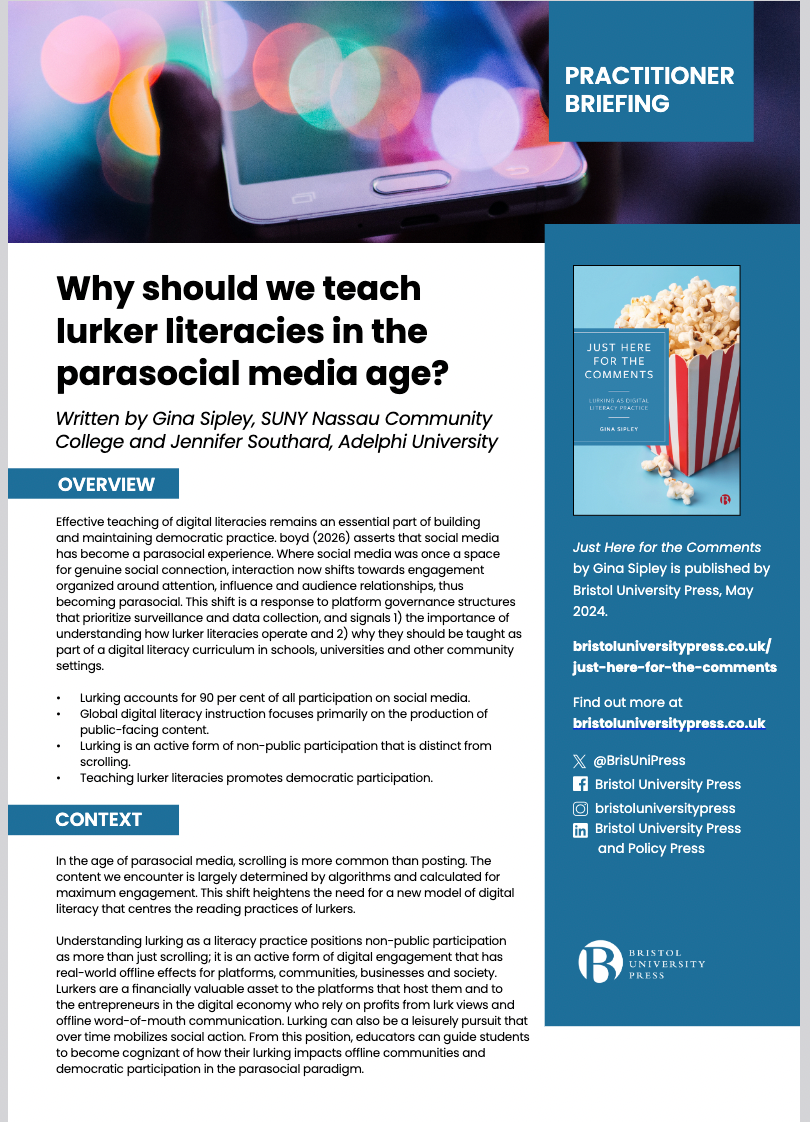
The full text of the briefing can be found here.
Speaking of democracy, the NY Times ran a rare interview with Mirjana Spoljaric, the head of the International Committee of the Red Cross. She poses a provocative question: Are we in the middle of a third World War? (Podcast Version link).
Among many important considerations, she highlights the need for teaching diplomacy, now.
Teaching diplomacy; however, also needs to include a more robust form of digital literacies, one that includes lurker literacies, particularly participatory restraint (where you strategically choose not to respond to content and limit its circulation).
Lurker literacies also offers hope by shifting the conversation to offline, real world, social action one might take while engaged in participatory restraint, like making a reoccurring monthly donation to the International Committee of the Red Cross. Part of teaching lurker literacies is understanding how to maximize impact. For example, monthly donations provide a reliable steady stream of income and allow organizations to sustain operations. It also positions them for further external funding when they can demonstrate a reliable operational budget.
Since 90% of all online participation is lurking, diplomacy depends on engaging the lurkers.
It's a tall task. But I know you're up for the challenge.
Thanks for walking beside me,